
Looking at this finely winged butterfly, it’s hard to imagine it would be able to navigate a flight of 50-100 miles in one day, and up to 3,000 miles total, to reach overwintering grounds in Mexico. Monarch butterflies (Danaus plexippus) are expected to be listed as a threatened species in 2025. Monitoring of monarchs has revealed an overall decline in numbers of adults by 85 percent since the mid-1990s.1
In Wyoming, there is little documentation about the locations and numbers of Monarchs. It may be that Wyoming populations prove important as recent research coming out of the University of Wyoming has shown Wyoming Monarchs may be free from a parasite which is impacting populations farther east.2
Not every generation of Monarchs migrate to Mexico. The first through third generations only live two to six weeks and spend their life in North America. Fourth generation Monarchs live an astounding nine months, migrate up to 3,000 miles and overwinter at latitude 19 degrees north.
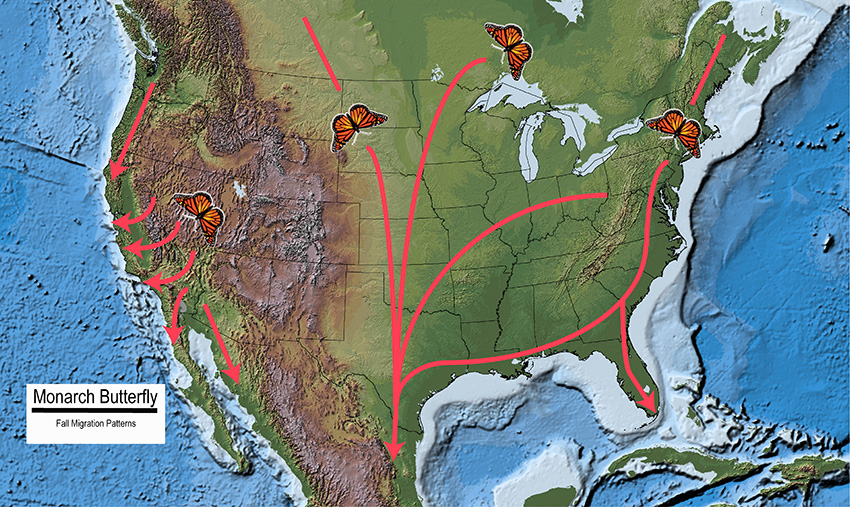
In the spring, as the butterflies fly north, they lay eggs. The butterflies from this egg laying make up the first generation. The first three generations of butterflies continue migrating north, finally reaching their northernmost destinations occupied by their great, great, grandparents.

The Rocky Mountains form the divide by which the Monarch butterfly populations are divided into eastern and western fly ways. Wyoming, dissected by the Rocky Mountains from north to south, only has Monarchs on the eastern part of the state.
The Monarchs’ ability to migrate thousands of miles to a place they have never been is not well understood. Current theories include the use of orientation to the sun and the earth’s magnetism to navigate. Still, that does not explain the instinct persisting across generations.
Adult Monarchs feed on the nectar of a variety of flowering plants. The female Monarch, however, only lays eggs on the Genus Asclepias, or milkweed plants. The survival of the Monarch is completely dependent on milkweed. There are 12 species of milkweeds in Wyoming. The most important for Monarch habitat is Showy milkweed (Asclepias speciosa).

The larva that hatch from eggs laid on milkweed feed solely on the milkweed plant. The larva feed almost constantly as they go through five developmental stages, or instars. Across the five instars, a monarch larva will grow almost 2,000 times its original size. The fifth instar caterpillar shows color patterns suggestive of the butterfly stage. The fifth instar caterpillar undergoes the well-known metamorphosis into the adult Monarch butterfly.

The occurrence and range of Monarchs in Wyoming is not well documented. Asclepias speciosa, while a native Wyoming plant and well adapted to our climate and soils, is also considered a noxious weed in four counties in Wyoming. A contradiction not lost on naturalists and advocates of sensitive species.
If you would like to report Monarch sightings, you can enter information at the Journey North website at www.journeynorth.org.
Sources:
 Wyoming Life